
Pakistan's powerful army chief has stepped in to mediate between the embattled government and the protesters seeking resignation of Prime Minister Nawaz Sharif, bringing the military back into the centre stage and signaling a possible end to the high-political drama.
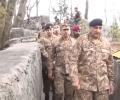
General Bajwa, unlike many of his predecessors, believes the Pakistan army's long-term interests lie in reducing tensions with India, reports Ajai Shukla.
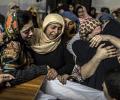
No one should be allowed to use Pakistan's territory to import or export terrorism, says Hamid Mir.
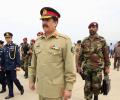
'This army has lost Pakistan's territory, ideology, financial and intellectual capital, ruined its institutions, democracy, the respect for its passport and, like it or not, reduced its status to a globally acknowledged university of jihad,' says Shekhar Gupta.

Swaraj said there is scope to do a lot more and this would be an important element of their deliberations.

At least 200 people were killed and more than 1,300 others injured today as a powerful 7.5- magnitude earthquake -- the strongest in 10 years --rocked Pakistan, sending severe shock waves as far as Punjab and PoK.

Dawn's Cyril Almeida said he had triple checked the facts on his story, which reported about the rift between the civilian government and the military in Pakistan.
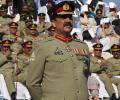
The recent postings and promotions of three-star generals in the Pakistan Army have propelled some of former chief Ashfaq Parvez Kayani's favourites to traditionally important positions

Operation Radd-ul-Fasaad launched to fight terrorism across country.

'The China Pakistan Economic Corridor is Pakistan's number one preoccupation today -- and tensions with India and the $46 billion projects simply do not go together,' points out Ambassador M K Bhadrakumar.

What does the Taliban chief's death means for various stakeholders?
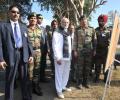
Denying the Pakistani investigators access to the Pathankot base on operational grounds would not, the government felt, compromise national security, reveals Rajeev Sharma.
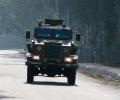
'The devious minds across the border will test us to the hilt, but in the course of that will offer us opportunities for which we must be prepared,' says Lieutenant General Syed Ata Hasnain (retd), who commanded the Uri Brigade, the Baramulla Division and the Srinagar-based Chinar Corps.
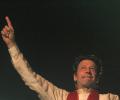
Both Messrs Imran Khan and Tahirul Qadri claim to march independently, but most of Pakistan believes they are marching to the Army's tune

The verdict was announced after the government submitted a 'new summary' to extend the service of 59-year-old Gen Bajwa.

'Many senior officers are unhappy with him, but many lower level officers are still supportive.' 'This is also not something that has happened for a long time. So this is certainly a milestone.'

'The biggest stumbling block will come from the traditionalists in the Pakistan army who have grown on a diet of anti-Indian propaganda and thinking on which much of their role -- both militarily and politically -- is centered upon.'

Describing the protests as a "mutiny against Pakistan", the government on Tuesday turned to Parliament for support as demonstrators continued to put pressure on a defiant Nawaz Sharif to quit as prime minister.

'There are retaliatory incursions, ambushes, captures and killings by Indian forces along the 700 km border; alleged spies are caught on both sides, then mutually traded as pawns; envoys are summoned in both capitals to be routinely given dressing downs.' 'And there is always a handy courier pigeon, like Sajjan Jindal, sent over to test the troubled waters,' says Sunil Sethi.

Brushing aside India's concerns, China on Monday cemented its "all-weather ties" with Pakistan by agreeing to build a strategic $46 billion (Rs 2.9 lakh crore) economic corridor through Pakistan-occupied Kashmir as part of 51 deals signed, expanding the communist giant's influence in the region.

The Afghan deputy foreign minister explains how his nation's President became disillusioned with Pakistan. Ajai Shukla listens in.
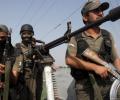
The Tehrik-i-Taliban Pakistan have claimed responsibility for the attack.
Two Army officers and five soldiers lost their lives in a major terrorist attack on Tuesday at an army base near Jammu in the town of Nagrota, just 20 kilometres from the border with Pakistan.
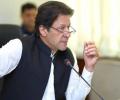
The apex court gave a month-long deadline to the government to determine the responsibility for security failure in the horrific attack in which 147 people, 132 of them children, were killed when Tehreek-i-Taliban Pakistan (TTP) militants stormed the Army Public School (APS) in Peshawar.

The cascade of cordiality on both sides after the Modi-Sharif handshake in Paris was preceded by much planning and even goading from UK, US and Germany.
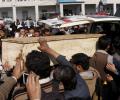
Extensive firing continues in the area and heavy contingents of elite force have been deployed.

Legendary Pakistani philanthropist Abdul Sattar Edhi, who had dedicated his life to humanity and serving the poor, died in Karachi from renal failure. He was 92.
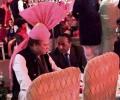
"Wearing the gifted turban of Modi itself shows that Sharif's sincere intention towards the neighbouring country. Besides, it also demonstrates that Sharif values the gift of Modi," a source added.

'Pakistan will try to escalate covert operations through terrorism,' says Dr Shalini Chawla.
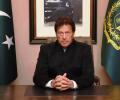
India cannot afford to be complacent about a possible Pakistan resort to military options across the LoC, warns Rana Banerji, who headed the Pakistan desk at the Research and Analysis Wing, India's external intelligence agency.
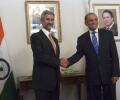
Pakistan's holy trinity -- its government, military establishment and the ISI -- differ on Pakistan's domestic and foreign policy issues. So when India talks to Pakistan's political leadership it can't be sure that the promises can be delivered, says Brigadier S K Chatterji (retd).
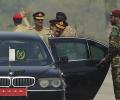
Bruce Riedel, a former CIA analyst who was one of the key architects of US President Barack Obama's Af-Pak policy during his first term, has called for an offensive strategy against terrorist networks and this includes hitting out at terrorist groups inside Pakistan.
Nawaz Sharif may have permitted the trial of Jaish-e-Mohammed terrorists for the Pathankot attack. But this fell apart because of General Raheel Shareef's keenness to make Kulbhushan Jadhav the centerpiece of global attention. Ambassador G Parthasarthy, a former Indian high commissioner to Pakistan, reveals the Pakistan army chief's gambit against India.
General Bajwa gets inputs from his senior officers, but he has the final word, notes Rana Banerji, who headed the Pakistan desk at the Research and Analysis Wing, India's external intelligence agency.
By weakening Sharif, the corps commanders could have a final say in important matters like relations with India, dealing with Taliban militants, interacting with Americans and once again achieving strategic depth in post-NATO Afghanistan. Which is why they may be behind the unrest in Pakistan led by Imran Khan and Dr Tahirul Qadri, says Shahzad Raza.

'Modi wants to be pragmatic -- acknowledge the problem of Pakistan and that full reconciliation is essentially a non-starter, but at the same time grab the low-hanging fruits (such as trade) to put things on a more even keel, to engender enough stability in the relationship to allow him to focus on other priorities.'
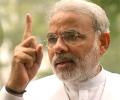
To be sure, Modi is no Vajpayee; at least that is the impression he gives. However, this doesn't mean that he will be looking for a fight. All it means is that if Pakistan seeks a fight, he will not back down. What it also means is that the pusillanimous approach of the previous governments to ceaseless provocations from Pakistan will probably change, says Sushant Sareen.
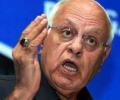
National Conference leader and former Jammu and Kashmir chief minister Farooq Abdullah has rejected the notion that the threat of a nuclear war would solve the Kashmir issue, asserting that the region would never be a part of Pakistan and dialogue is the best way to "move forward".

A grieving Pakistan's policy shift towards the Taliban has comes at a great cost, says Shahzad Raza.

'A Russia-Iran-China-Pakistan geopolitical grouping is evolving at this point of time.' 'Given that the grouping is in its nascent stages, will this week's terrorist attack in Mirjaveh affect it?' asks Aveek Sen.
